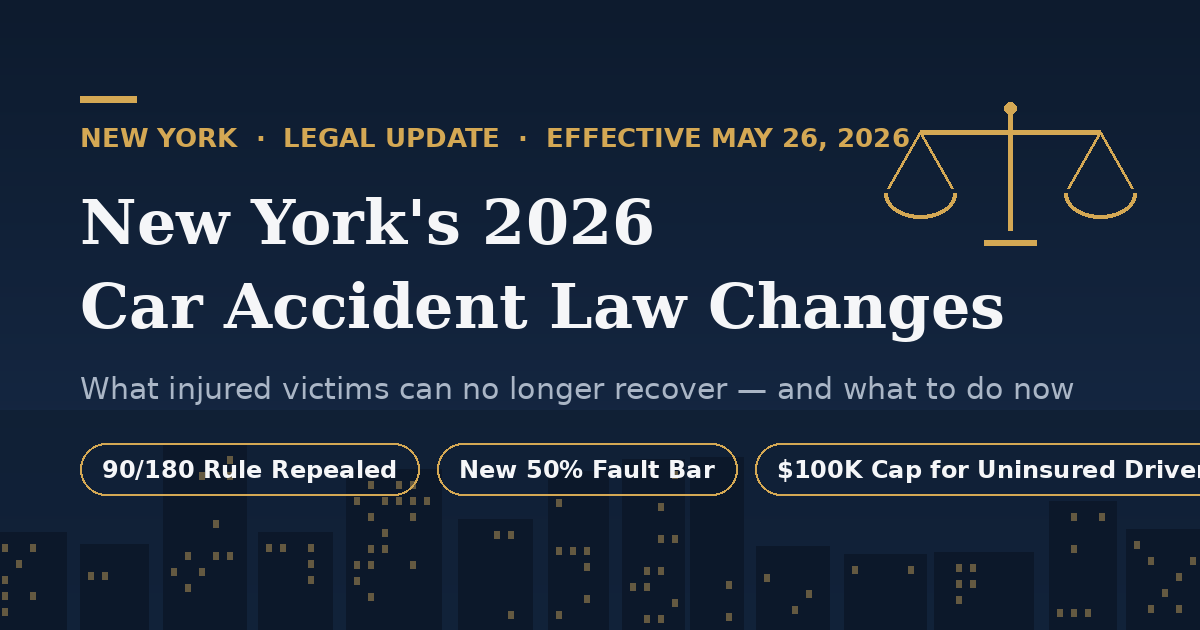
If you were in a car accident in New York before May 26, 2026, the old rules apply to your case. If your crash happened after that date, you're playing a different game entirely — and most people don't know it yet.
This spring, Albany passed the biggest rewrite of New York's auto accident laws in decades. It came through the state budget, tucked inside Bill A10008, and it took effect immediately for any lawsuit filed on or after May 26, 2026. The stated goal was to lower insurance premiums by cutting down on fraud and what lawmakers called "jackpot payouts."
Whatever you think of that goal, here's the part that matters to you: several doors that injured New Yorkers used to walk through are now closed. This article explains which ones, in plain English, and what you should do differently if you've been hurt in a crash.
The 90/180 rule is gone — and that's the big one
For years, New York's no-fault system had a safety valve. Even if your injury wasn't permanent, you could still sue for pain and suffering if it kept you from your normal daily life for at least 90 out of the 180 days after the accident. Lawyers called it the 90/180 rule, and it lived inside the definition of "serious injury" in Insurance Law § 5102(d).
Think about who used that rule. The delivery driver with a back injury that healed in five months but kept him off the job the whole time. The mother with a concussion who couldn't drive, work, or care for her kids for a full season. Their injuries weren't permanent — but their lives were genuinely turned upside down.
As of May 26, 2026, that category no longer exists. The legislature deleted it.
What's left of the serious injury definition are the harder categories: death, dismemberment, significant disfigurement, a fracture, loss of a fetus, permanent loss of use of a body organ or member, permanent consequential limitation, and significant limitation of use of a body function or system.
Notice what those have in common. Almost all of them require either something visible (a broken bone, a scar) or something permanent. Soft-tissue injuries, concussions, and chronic pain conditions — injuries that are very real but hard to photograph — just got much harder to bring to court.
There's a procedural change riding along with this, too. Under the amended law, a jury now has to find that a serious injury exists before liability for pain-and-suffering damages can even be fixed. In practice, that means your medical proof isn't one piece of your case anymore. It's the gate the entire case has to pass through.
The new 50% rule: too much fault, zero recovery
Here's the second major change, and it may end up affecting more people than the first.
New York used to follow pure comparative negligence. If you were 60% at fault for a crash and your damages were $100,000, you could still recover $40,000. Your share of the blame reduced your recovery — it never erased it.
Not anymore. The new CPLR § 1411(b) says that in motor vehicle injury cases covered by the no-fault law, a person found more than 50% at fault recovers nothing for that injury. Not a reduced amount. Nothing.
Why does this matter so much? Because fault in a car accident is almost never a clean number. It's an argument. Insurance companies have always tried to pin some percentage of blame on the injured person — you were speeding a little, you braked late, you could have swerved. Under the old law, winning that argument saved them some money. Under the new law, pushing you past the 50% line makes your entire claim disappear.
You can expect insurers to fight harder over fault than they ever have. Dashcam footage, phone records, accident reconstruction — the evidence battle starts the day of the crash now, not the day a lawsuit is filed.
A $100,000 cap for certain drivers
The third change is narrower, but if it applies to you, it's severe. A new Insurance Law § 5104(d) caps pain-and-suffering damages at $100,000 for an injured person who, at the time of the accident, was:
- Driving their own uninsured vehicle (unless the coverage lapse was under 30 days),
- Driving impaired and later convicted of it, or
- Committing a felony (or fleeing one) and later convicted.
The cap doesn't apply to cases where the person died. And it doesn't touch economic damages like medical bills and lost wages. But for anyone who let their insurance lapse to save money — and plenty of people in this economy have — it's a harsh new reality. A 31-day lapse at the wrong moment can now cost you everything above $100,000, no matter how badly you were hurt.
Staged accidents: the organizers are now on the hook
One change almost everyone can agree with. Under the amended Penal Law § 176.05, a person who hires, encourages, or orchestrates someone else to stage a car accident has committed a fraudulent insurance act themselves. The law finally reaches past the driver behind the wheel to the people running the scheme.
If you've been the innocent victim of what you suspect was a staged crash — a car that brake-checked you out of nowhere, "witnesses" who appeared too quickly — this change works in your favor, and it's worth telling your lawyer about those suspicions early.
What didn't change (but still trips people up)
With all the noise about the new law, don't lose sight of the old rules that are still very much alive:
New York is still a no-fault state. Your own insurance pays your initial medical bills and lost wages through Personal Injury Protection, regardless of who caused the crash. And the deadline that catches people every single year is still there: you generally have just 30 days to file your written no-fault claim with the insurer. Miss it, and you can lose benefits you were entitled to before your case even begins.
The minimum insurance requirements haven't moved either — 25/50/10 liability coverage, plus mandatory uninsured motorist coverage and PIP. And the statute of limitations for most car accident injury lawsuits in New York remains three years from the date of the crash, with much shorter notice deadlines if a government vehicle or municipality is involved.
What to do after a crash under the new law
The law changed. The playbook has to change with it.
See a doctor immediately, and keep going. With the 90/180 category gone, your case likely depends on proving a fracture, disfigurement, or a permanent or significant limitation. That proof comes from consistent medical records — MRIs, specialist evaluations, documented range-of-motion testing. Gaps in treatment were always damaging. Now they can be fatal to a claim.
Protect the fault evidence from day one. Photos of the vehicles and the scene, dashcam files, the names of witnesses, the police report number. Under the 50% bar, the fault fight is the whole ballgame, and evidence disappears fast.
File your no-fault paperwork inside 30 days. Whatever else is going on — pain, insurance calls, car repairs — this deadline comes first.
Don't give the other insurer a recorded statement. Every word will be measured against that 50% line. There is no version of that call that helps you.
Talk to a lawyer before you assume you don't have a case. Plenty of injuries that fail one serious-injury category qualify under another. Whether yours does is a medical-legal question, not something to decide from a Google search at 2 a.m. Our New York car accident lawyers review cases under the new 2026 framework and can tell you honestly where you stand — the consultation is free.
Frequently asked questions
Does the new law apply to my accident from before May 2026?
The changes apply to lawsuits commenced on or after May 26, 2026. If your crash happened earlier but you haven't filed yet, the timing of your filing matters enormously — this is a question to put to a lawyer this week, not this month.
I have whiplash and herniated discs. Can I still sue?
Possibly. Soft-tissue injuries lost their easiest path when the 90/180 rule was repealed, but they can still qualify as a "significant limitation" or "permanent consequential limitation" with the right medical documentation. The strength of your records will decide it.
The insurance company says I was mostly at fault. Is my case over?
No — their opinion isn't a verdict. Fault over 50% now bars recovery, which is exactly why insurers will claim it aggressively. An independent investigation often tells a different story than the adjuster's version.
Will my insurance premiums actually go down because of this?
That's the promise. The law also added new oversight of rate increases starting in late November 2026. Whether savings actually reach drivers is something the whole state is waiting to see.
This article is for general information only and is not legal advice. Laws change and every case is different. Attorney Advertising.